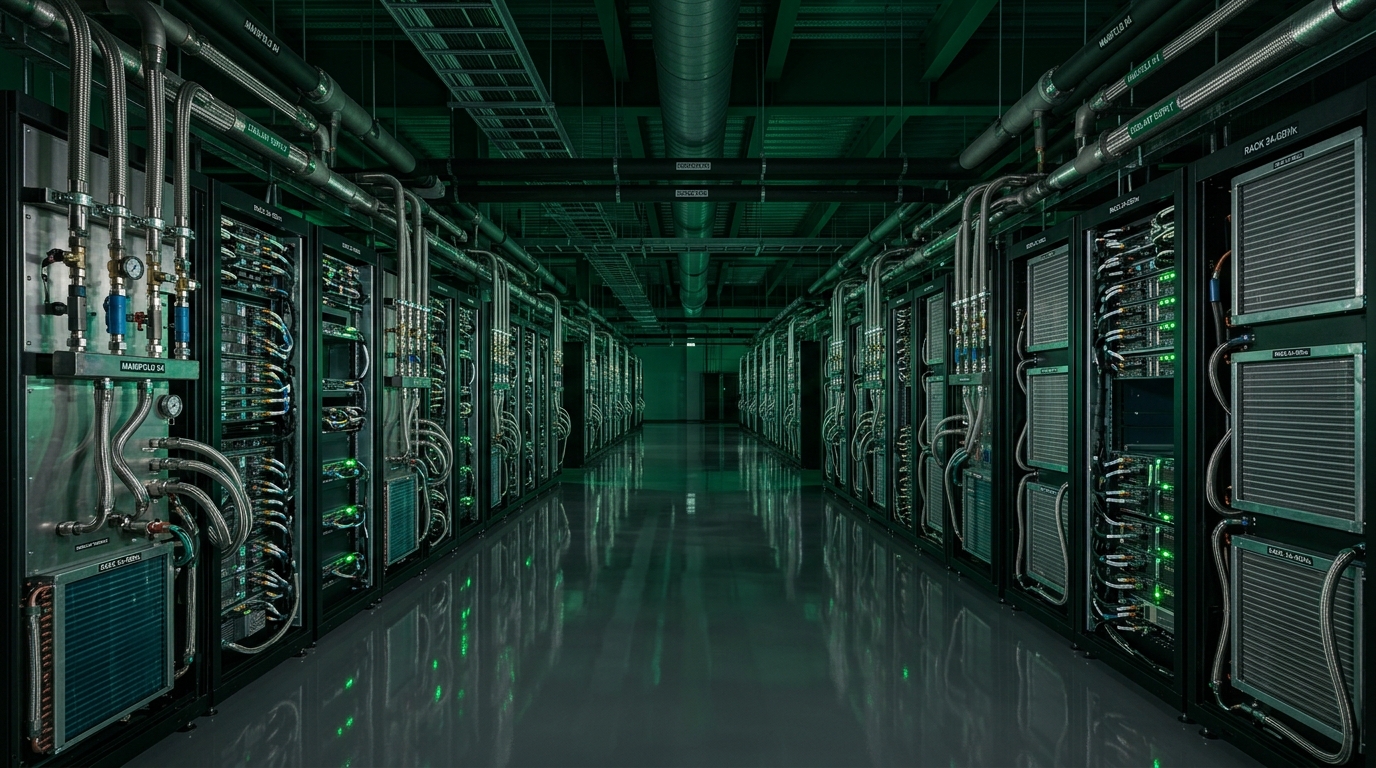
The Density Problem Nobody Talks About
High-density compute racks — 30kW to 100kW+ each — generate heat that traditional air cooling simply can’t remove efficiently at scale. The usual fix, evaporative cooling, solves the heat problem by consuming enormous volumes of municipal and groundwater.
We design for both constraints simultaneously, targeting an annualised PUE (Power Usage Effectiveness — the ratio of total facility power to the power actually reaching compute load) below 1.2, alongside a Water Usage Effectiveness (WUE) below 0.20.
Water Is the Last Resort, Not the Default
Rather than reaching for water-hungry evaporative systems first, we design cooling strategies where chillers, rear-door heat exchangers, and dry cooling do the bulk of the work. Water use is minimised and applied sparingly only through hybrid approaches where it adds genuine thermodynamic efficiency.
Where water does play a role, we explore closed-loop hybrid architectures combining dry and liquid methods, ensuring the facility consumes only what is strictly necessary rather than what is conventionally convenient.
Mechanical Systems Built Around Liquid, Not Evaporation
Rather than retrofitting cooling infrastructure after structural construction, we engineer the mechanical envelope around closed-loop chilled water, direct-to-chip liquid loops, or immersion cooling from the outset.
Each approach eliminates continuous evaporative water consumption — meaning the facility isn’t drawing municipal or borehole water every single day of operation, regardless of external ambient temperature or seasonal climate shifts.
Waste Heat Becomes a Neighbour’s Resource
Heat rejected from high-density compute does not have to be discharged into the atmosphere. We design integrated heat re-use pathways, including:
- Municipal District Heating Networks: Piping recovered thermal energy directly into nearby residential developments, civic facilities, or commercial hubs.
- Co-Located Industrial Processes: Feeding consistent low-grade waste heat into facilities such as anaerobic digestion plants, where sustained thermal input materially enhances digester biological efficiency.
This methodology converts what was traditionally a compliance burden into an authentic sustainability asset and potential ancillary revenue stream.
Zero-Discharge Drainage, Not Just Compliance
Every originated campus incorporates on-site water attenuation ponds, rainwater harvesting, and interceptors engineered for zero-discharge Sustainable Drainage Systems (SuDS).
This approach leaves local watercourses and hydrogeological tables unaffected, while proactively supporting biodiversity net gain quotas of +20% — transforming statutory requirements into a distinct planning advantage.
Thermal Criteria & Benchmarks
| Metric | Target |
|---|---|
| Annualised PUE | Below 1.2 |
| Water Usage Effectiveness (WUE) | Below 0.20 |
| Sustainability Profile | Net-zero optimised, with heat re-use embedded |
Call to Action
Talk to us about a cooling strategy engineered before ground is broken. Reach out to our technical engineering team to review site mechanical envelopes and thermal diligence packs.