Introduction
As institutional investors and hyperscale tenants (Microsoft, AWS, Google, Meta) commit to stringent Net Zero 2030 targets, environmental performance has evolved from a branding exercise into a core valuation driver.
Facilities that fail to address thermal pollution and water consumption face planning resistance, public pushback, and potential carbon taxation. Conversely, campuses that export low-grade server exhaust heat into municipal District Heating Networks (DHNs) unlock significant regulatory goodwill, operational cost offsets, and institutional yield premiums.
1. The Physics of Data Centre Heat Recovery
A 50MW data centre operating at capacity produces approximately 49MW of continuous thermal energy (with 2% lost to unrecoverable electrical and connection point inefficiencies). In conventional facilities, this energy is rejected into the atmosphere via cooling towers or dry coolers.
With modern liquid cooling (direct-to-chip and immersion), heat capture efficiency increases dramatically. The diagram below illustrates how high-voltage electrical energy enters the compute environment, how thermal energy is divided between district heating heat pumps, industrial feedstock processes, and ambient air rejection, and how an industrial heat pump boosts the temperature from 30°C–40°C up to 60°C for community district heating networks:
By extracting water at 30°C–40°C from the primary liquid heat exchanger and lifting it to 60°C using high-efficiency water-source industrial heat pumps (COP 4.2), alongside direct thermal feedstock export for regional food production and anaerobic digestion, a 50MW facility provides low-temperature district heat for up to 10,000+ residential homes and civic facilities annually without fossil fuel combustion.
2. Municipal Alignment & Local Authority Off-take
In the UK, the Department for Energy Security and Net Zero (DESNZ) has allocated substantial capital through the Green Heat Network Fund (GHNF) to subsidize district heating infrastructure.
The Strategic Advantages for Data Centre Origination:
- Unlocks Planning Approvals: Local authorities under pressure to decarbonize municipal housing prioritize data centre applications that supply free or low-cost waste heat.
- Additional Revenue / Carbon Credits: Long-term heat purchase agreements (HPAs) with municipal energy companies provide predictable indexed cash flows.
- Enhanced Corporate Tenant Stickiness: Hyperscalers actively seek facilities that can demonstrate tangible Scope 1 and Scope 2 emission reductions.
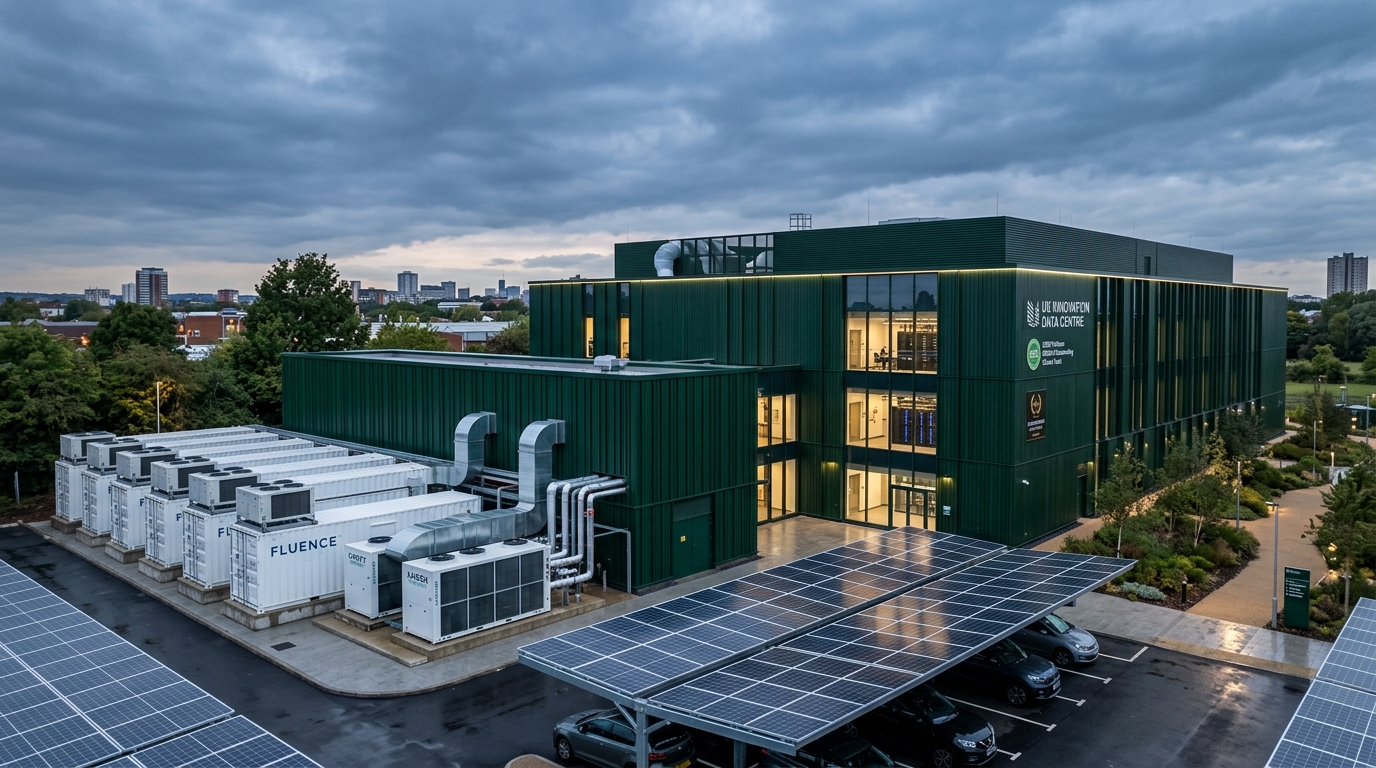
3. Co-located Solar PV & Battery Energy Storage (BESS)
Alongside district heating, UK Data Development integrates on-site renewable generation into all master development boundaries:
- Rooftop Solar PV: 2MWp to 5MWp arrays mounted on building envelopes, powering non-IT auxiliary systems and administrative facilities.
- Co-located Battery Storage: 20MWh to 50MWh BESS installations providing frequency response services to the National Grid and peak shaving during high-tariff periods.
Conclusion
Integrating district heating and on-site renewables is not merely an environmental safeguard—it is a de-risking catalyst that accelerates planning consents, improves local stakeholder alignment, and delivers measurable institutional ESG outperformance.