The Real Bottleneck Isn’t Land. It’s Power.
Across Europe, the data centre industry has a land problem that’s actually a power problem. Sites get bought, plans get drawn — and then developers discover the grid connection queue is years long, or the nearest substation can’t take the load. We remove that risk before it becomes yours.
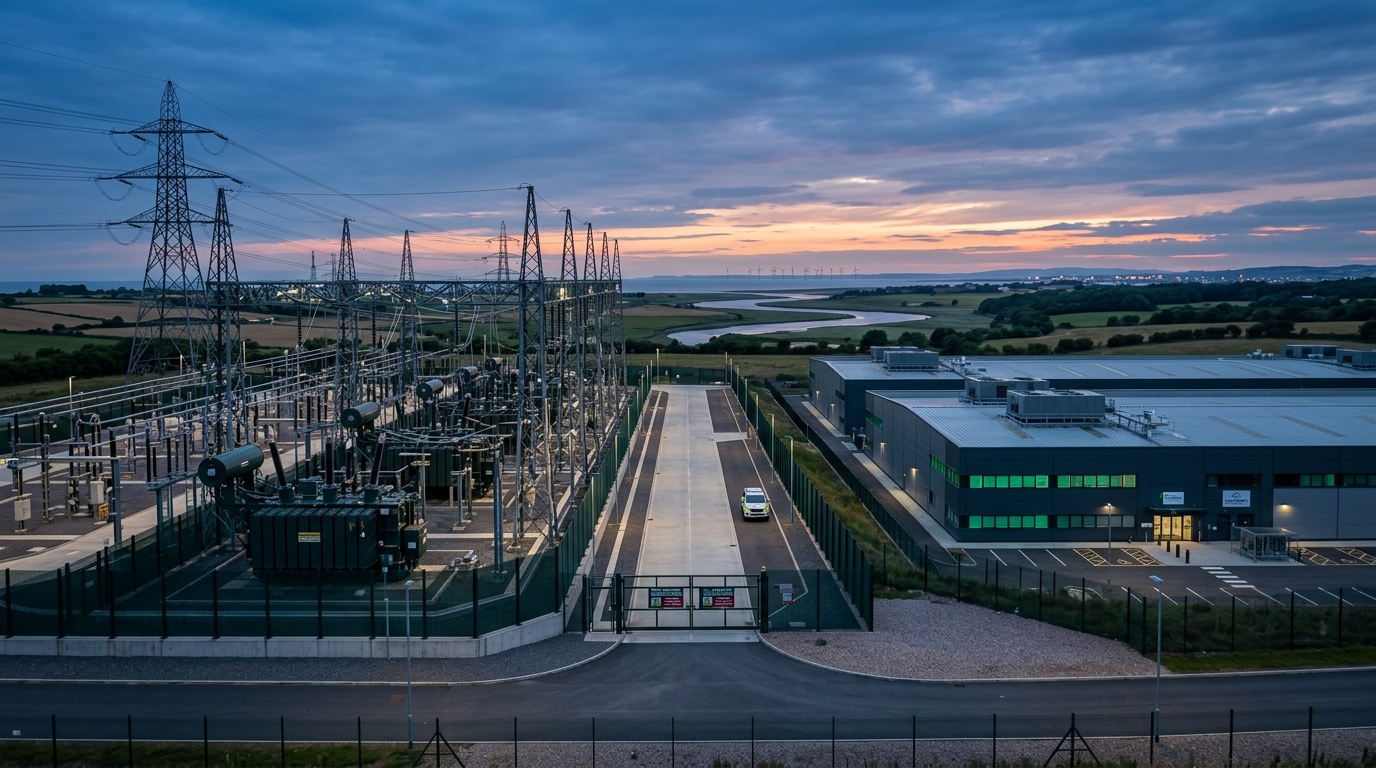
Every parcel we originate sits within direct proximity — under 1km — of an 11kV, 33kV, or 132kV primary substation, with a viable connection pathway already identified for facilities up to 50MW. Power availability, the single largest constraint in this sector, is solved at the acquisition stage, not discovered after it.
We Talk to the Grid Operator Before You Commit
Before any land agreement is signed, we engage directly with the regional Distribution Network Operator (DNO — the company that owns and manages the local electricity network) to check three things: whether the point of connection can actually take your load, what capacity the local transformers have registered, and where that substation sits in the connection offer queue.
In the UK, this means direct, bilateral engagement with the licensed network operators across our target geographies — including UK Power Networks (UKPN), National Grid Electricity Distribution (NGED), SP Energy Networks, Scottish and Southern Electricity Networks (SSEN), Electricity North West (ENWL), and Northern Powergrid.
This means you’re not buying a hopeful location. You’re buying a validated one, with the groundwork for a connection agreement already underway.
Shorter Cable Runs Mean Fewer Problems
Keeping connections under 1km isn’t just about speed — it changes the economics of the entire build. Shorter cable routes mean less civil engineering work off-site, lower transmission losses (the energy that bleeds away over long cable runs), and no need to negotiate wayleaves — the legal permissions to run cables across other people’s land — across multiple private landowners.
Fewer parties involved means fewer points where a project can stall.
Built for Resilience, Not Just Connection
For workloads that can’t tolerate downtime, we go further. We assess private wire feasibility — dedicated cable corridors that bypass the shared public network — alongside dual-circuit feeds across 11kV, 33kV, and 132kV lines from independent primary transformers.
We actively assess whether dual-feed redundancy is possible for each site asset, evaluating independent transformer allocations and physical trench diversity.
The result is tier-grade resilience: if one feed fails, an independent second one carries the load, so a single point of failure never becomes an outage.
Ready to Accelerate Delivery?
Talk to us about a site with power already secured. Our team works directly with institutional developers, hyperscalers, and infrastructure funds to unlock de-risked capacity.